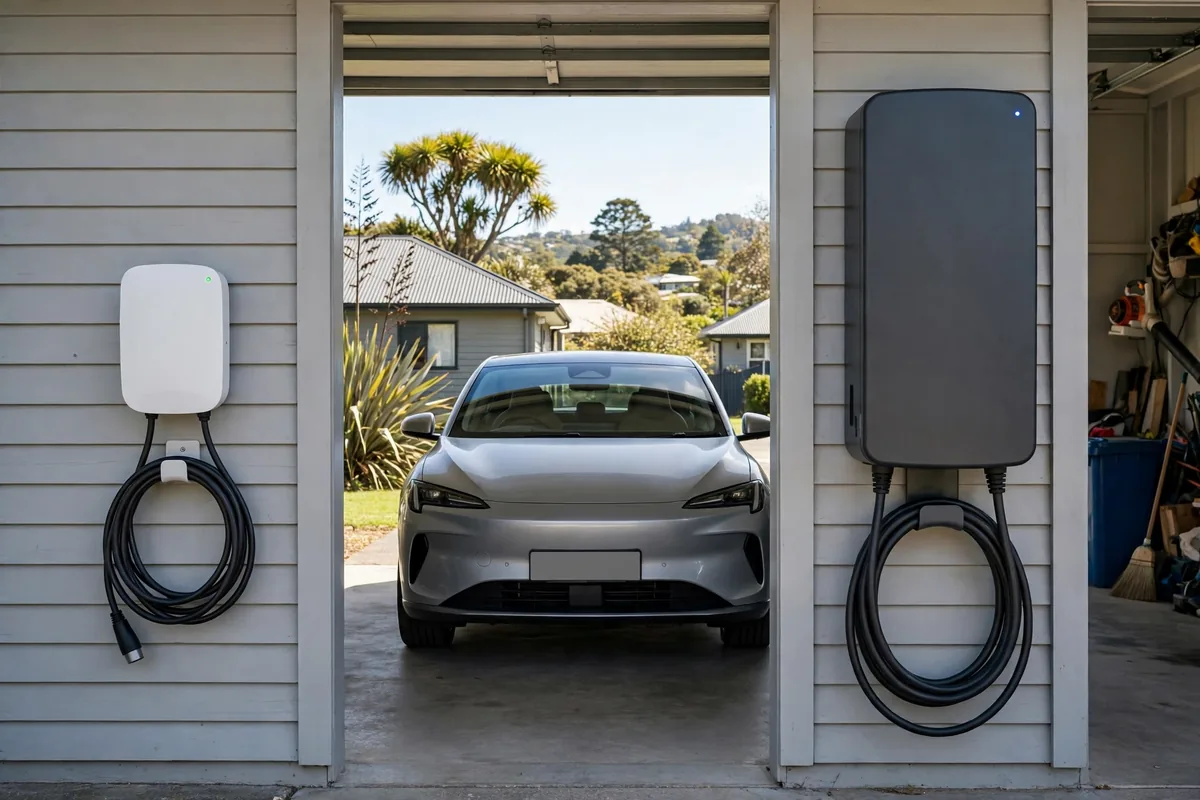
What the numbers actually mean
The kilowatt figure on a home charger describes the maximum rate at which it can deliver power to your car. A 7.4kW charger runs on single-phase power, which is what most New Zealand homes have, at 230V. A 22kW charger needs three-phase power — three live conductors instead of one — which some larger homes, rural properties and commercial sites have, and most suburban homes do not. That supply distinction, more than anything else, decides which charger belongs at your place.
As a rough guide to what the rates feel like, 7.4kW adds around 40 kilometres of range per hour of charging. A 22kW unit charging a car that can accept the full rate adds range roughly three times as fast. That sounds decisive until you add the two constraints that govern real life: your car may not be able to accept 22kW at all, and your car sits parked at home for far longer than it needs to charge. The sections below work through both constraints so you can judge the comparison against your own driving, not a brochure.
The hidden limit: your car's onboard charger
AC charging — which is what all home wall chargers provide — passes through a component in your car called the onboard charger, which converts AC power to DC for the battery. That component has its own maximum rate, and it caps your home charging speed no matter how powerful the wall unit is. Many EVs sold in New Zealand limit AC charging to 7.4kW. Others accept 11kW. Only some models accept the full 22kW. Fitting a 22kW wall charger to a car limited to 7.4kW delivers exactly 7.4kW — plus a larger bill.
This is the single most common misunderstanding in home charging, and it is worth checking before you spend anything. Your car's manual or specification sheet lists its maximum AC charging rate. If it says 7.4kW, your decision is already made. If it says 11kW and your home has three-phase supply, a three-phase charger gives you a genuine, if moderate, gain. If it says 22kW, the full benefit is available to you — subject to your supply and how much you actually drive, which is where the conversation turns next.
Do you have three-phase power? How to find out
Three-phase supply is common in larger homes, homes with big ducted heating or certain pumps, lifestyle blocks, workshops and commercial premises. Around Tauranga, you are more likely to find it in bigger established properties — parts of Bethlehem, for example — and in commercial settings like the Tauriko Business Estate than in a standard new subdivision home in Papamoa or Pyes Pa, which are almost always single-phase. Visual clues include a larger main switch arrangement at your switchboard and labelling that refers to three phases.
Clues are not confirmation, though. The reliable way to know is to have a registered electrician inspect your switchboard and supply, which happens naturally as part of an installation assessment. They can also tell you what upgrading to three-phase would involve if you do not have it — and for most households, that upgrade is significant work involving your network company, which is rarely justified by home car charging alone. If you already have three-phase for other reasons, the calculation changes completely, and a higher-rate charger becomes a modest extra rather than a major project.
The overnight test: how much speed do you actually need?
Run your own numbers before choosing. Take your typical daily driving — say a Papamoa to CBD commute, school runs and errands totalling 60 kilometres. On a 7.4kW charger at roughly 40 kilometres of range per hour, that day is replaced in about an hour and a half. Even a heavy 200-kilometre day needs only around five hours. Your car is likely parked at home for ten to twelve hours overnight. The inescapable conclusion for most households is that 7.4kW is not the bottleneck in their lives; the car finishes charging long before they need it.
Now consider when 22kW genuinely earns its keep. High-kilometre drivers who arrive home late with a near-empty battery and leave early for another long day benefit. Households running two EVs off one charging setup, where each car gets only part of the night, benefit. Commercial users — vans in Tauriko returning to base, for instance — benefit when turnaround time matters. If none of those descriptions sound like you, the honest recommendation is the standard charger, and the money saved is better kept or spent on correct installation, protection and placement.
What drives the cost difference between the two
Where both options are possible, a 22kW installation generally costs more than a 7.4kW one for several compounding reasons. The charger unit itself is typically more expensive. The cabling and protection for three-phase work involve more conductors and larger components. And if your home does not already have three-phase supply, bringing it in is a separate, substantial job involving network approval — a different league of cost from the charger itself. For context, installed home chargers in New Zealand typically fall in a market range of about $1,450 to $3,700 overall, and three-phase jobs tend to sit in the upper portion of or beyond typical single-phase pricing depending on the site.
We publish ranges like that for budgeting only — this site is a referral service and does not quote prices. Your registered electrician quotes your actual job after assessment. The useful discipline when comparing options is to price the outcome, not the headline number: ask what each option delivers for your car and your driving. If the 22kW path costs significantly more and delivers charging speed your car cannot use or your routine does not need, it is not an upgrade. It is simply a bigger invoice for the same morning result: a full battery.
Two EVs, load management and the middle path
Between the extremes sits the situation many Tauranga families are heading toward: two EVs, one house supply. Two cars charging simultaneously at full rate can exceed what a single-phase home supply should deliver alongside normal household loads. The answer is usually not three-phase conversion. Smart chargers offer load management — sharing available power between vehicles, or pausing and resuming charging based on what the house is using — so both cars charge overnight within the supply's limits, and both are ready by morning because neither needed the full night anyway.
There is also a hardware middle path worth knowing about. If your home has three-phase supply and your car accepts 11kW, an 11kW three-phase charger gives you about half-again the speed of 7.4kW without the full cost of a 22kW setup, and many 22kW-capable chargers can be configured to run at lower rates. The broader point is that charger selection is a matching exercise — supply, car, driving pattern — not a ladder where higher is automatically better. A good installer will ask about all three before recommending anything.
The verdict for most Tauranga homes
For the majority of households in Tauranga, the verdict is clear: a 7.4kW single-phase charger is the right choice. It suits standard home supply, it matches or exceeds the AC limit of a large share of EVs on New Zealand roads, and it restores a full day's driving in a small fraction of the night. It is also the installation your electrician does most often, which keeps pricing competitive within the typical market range and the process simple from assessment to Certificate of Compliance.
Choose 22kW when the evidence supports it: three-phase already at your property, a car that can accept the rate, and a driving pattern — high kilometres, two EVs sharing time, commercial turnaround — that genuinely uses the speed. If you are unsure which camp you are in, that is exactly what an assessment is for. Tell your electrician your car model, your daily kilometres and show them your switchboard, and let those three facts decide. Numbers on a box should never outvote the reality of your own driveway.
Get Help With EV Charging in Tauranga
Reading only gets you so far — your switchboard, your car and your parking spot decide the real answer. We connect Tauranga homeowners with local registered electricians who install and certify home chargers every week.