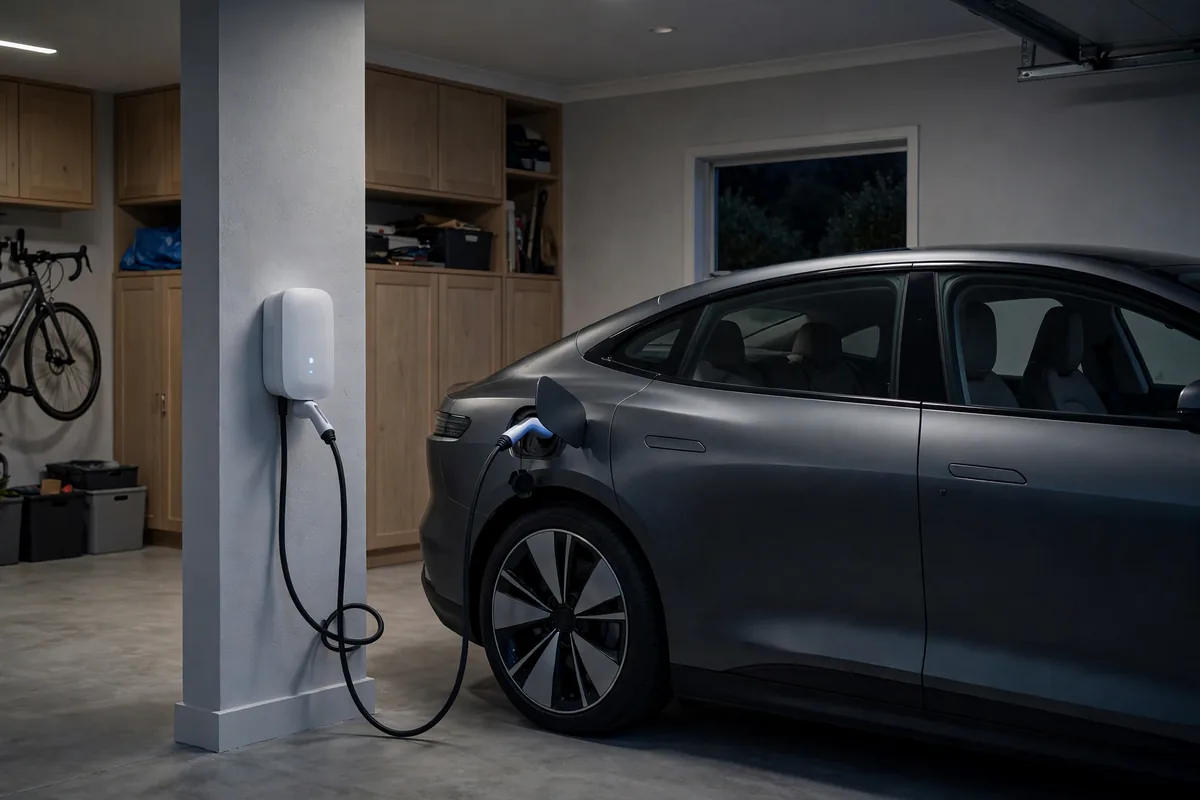
Start with the three ways to charge at home
Every New Zealand EV owner effectively chooses between three home charging options. The first is the portable three-pin cable that comes with most cars, often called a granny cable. It plugs into an ordinary household socket and draws a modest current, adding range slowly. It is genuinely useful as a backup and for occasional top-ups at a bach or a friend's place, but it was designed as a convenience accessory, not as a permanent daily charging system for a car you rely on every morning.
The second option, and the standard recommendation for most households, is a dedicated wall-mounted charger on its own circuit. On New Zealand's 230V supply, a single-phase wall charger delivers 7.4kW, which transforms the experience completely. The third option is a three-phase charger delivering up to 22kW, available only in homes with three-phase supply and only useful if your car can accept that rate. The rest of this guide focuses mainly on the second option, because it is the right answer for the great majority of Tauranga homes, from Papamoa new builds to established houses in Otūmoetai.
Charge times: 7.4kW versus the granny cable, honestly
Numbers help here, as long as they are used as guides rather than promises. A 7.4kW wall charger adds roughly 40 kilometres of range per hour of charging — an average industry figure that varies a little with your car's efficiency. Plug in for two hours in the evening and you have added around 80 kilometres, which covers most people's entire day of driving around Tauranga. Leave it plugged in overnight and even a large battery that arrived home nearly empty will typically be full or close to it by morning.
Compare that with the portable cable, which adds range at only a fraction of that pace. An overnight session on a granny cable might restore a light day's driving, but back-to-back big days — a work commute, an evening trip to Hamilton, a weekend run — will outrun it. Owners feel this as low-grade range anxiety: not stranded, just constantly aware of the percentage. The wall charger's real benefit is not raw speed for its own sake. It is that charging stops being something you think about, because the car is simply ready every single morning.
Type 2, tethered or untethered: choosing your charger
Almost every EV sold new in New Zealand charges on AC through a Type 2 connector, which is why home chargers here are Type 2 units. Your main practical choice is between a tethered charger, which has its cable permanently attached, and an untethered or socketed unit, where you plug in your own cable. Tethered is the most convenient for a single household car: you unhook the cable, plug in, and hang it back up. Untethered suits some shared or design-sensitive situations and lets you swap cable lengths, but means handling your own cable every day.
Beyond that, features divide into genuinely useful and nice-to-have. Scheduling — setting the car or charger to draw power during off-peak hours — is useful for almost everyone. App monitoring is handy if you like seeing what each charge cost. Solar-aware charging matters if you have panels or firmly plan to install them. Load management matters if your switchboard capacity is tight or you expect a second EV. Pay for the features that match your home and habits, and be sceptical of paying extra for charging speeds your car's onboard charger cannot accept anyway.
What installation actually involves, step by step
A proper installation starts before anyone picks up a drill. You share your suburb, your vehicle, where the car parks and ideally a photo of your switchboard. A registered electrician assesses capacity, the cable route and any issues with the board, then provides an itemised quote covering the charger, the dedicated circuit, protection, labour and certification. Only once you have accepted that quote in writing does work get booked. That sequence protects you: surprises belong in the assessment stage, not on installation day.
On the day, most straightforward Tauranga installations take half a day. The electrician isolates power for part of the work, runs the new dedicated circuit from the switchboard to the charger position, fits the required protection, mounts and connects the charger, then tests it under load. Before leaving, they should set up the app or schedule with you, show you how everything works, and provide your Certificate of Compliance. From that evening onwards, your routine is simply: park, plug in, and let the schedule handle the rest.
The rules that protect you: electricians, CoC and RCDs
In New Zealand, installing a fixed EV charger is prescribed electrical work. It must be carried out by a registered electrician, and on completion you must receive a Certificate of Compliance confirming the work meets safety requirements. This is not bureaucratic decoration. The certificate is your proof for insurance purposes, it belongs in your property records if you sell, and it is your assurance that a continuous load running for hours every night was installed to standard. Any installer who is vague about certification is telling you something important about themselves.
Protection matters just as much. EV chargers can produce smooth DC fault currents that ordinary household RCDs may not detect, which is why installations require a Type B RCD or the manufacturer-specified equivalent protection. Guidance in SNZ PAS 6011:2023 covers how chargers should be selected and installed safely in New Zealand. When you compare quotes, check that the RCD type and the CoC are explicitly included. A cheaper quote that quietly omits correct protection is not cheaper — it is incomplete, and it is your household carrying the difference.
What it costs: the typical New Zealand range
Budgeting is easier with honest ranges. Based on research of the current New Zealand market, most homeowners pay somewhere in the typical range of $1,450 to $3,700 in total for a home charger supplied and installed. Straightforward jobs — modern board, short cable run, standard 7.4kW unit — sit toward the lower end. Jobs climb when the cable run is long, the charger has more features, trenching is needed, or the switchboard needs upgrading first, as happens more often in older suburbs such as Greerton and Welcome Bay.
Be clear about what this site is: a referral service, not the installer. We do not quote prices, and no figure in this guide is a quote for your home. Your actual price comes from the registered electrician we connect you with, after they assess your property, and it should be itemised so you can see what you are paying for. There is no New Zealand government subsidy for home chargers in 2026, though some banks offer green home loan products for energy improvements — worth asking your own bank about if spreading the cost would help.
Solar, off-peak timing and getting the most from your charger
Two habits extract most of the value from a home charger. The first is timing: if your power plan has cheaper off-peak hours, schedule charging into them. Most chargers and many cars make this a set-once feature — you plug in when you get home and the car waits for the cheap window before drawing power. The second habit applies if you have rooftop solar: a solar-aware charger can direct surplus generation into the car during the day instead of exporting it, which suits households where the car is home during daylight hours, including weekends and work-from-home days.
Neither habit requires obsession. Tauranga's driving patterns — commutes from Papamoa or Pyes Pa, school runs, weekend trips to the beach or Rotorua — are comfortably covered by overnight charging on a standard 7.4kW unit. Solar integration and careful scheduling are refinements that trim running costs further, not prerequisites for home charging to make sense. Start with a correctly installed, certified charger and a simple off-peak schedule. That combination alone delivers most of the benefit, and you can refine from there once you see your own usage patterns in the app.
Get Help With EV Charging in Tauranga
Reading only gets you so far — your switchboard, your car and your parking spot decide the real answer. We connect Tauranga homeowners with local registered electricians who install and certify home chargers every week.