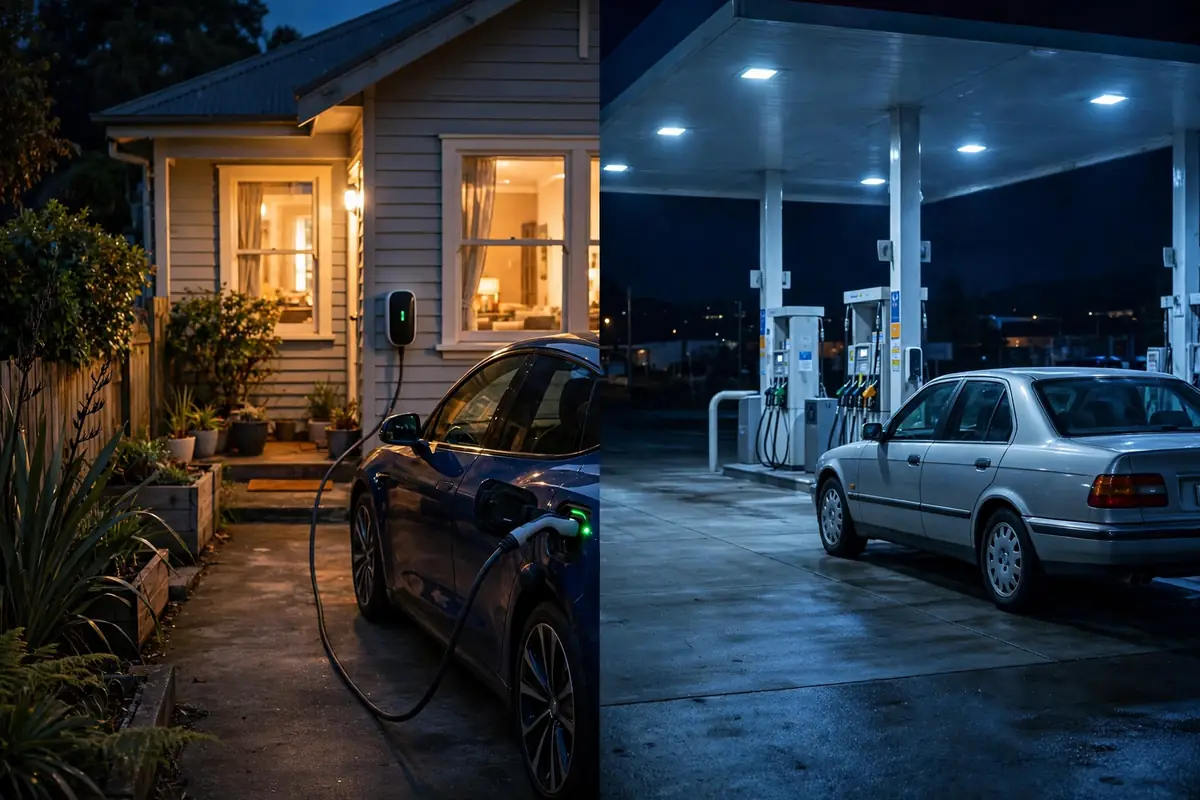
The comparison that starts the conversation: petrol at $3.50 a litre
With petrol in New Zealand sitting around $3.50 a litre, the fuel cost of a conventional car is easy to feel every time you fill up. A typical petrol car travelling a few hundred kilometres a week burns through a tank regularly, and every litre is bought at the full retail price, at whatever time of day you happen to need it. There is no off-peak petrol, no charging it from your roof, and no way to buy this month's fuel at last month's price. That inflexibility is a large part of what EV running costs improve on.
An EV charged at home draws electricity you are already connected to, at the per-unit price of the plan you already chose, mostly while you sleep. Even without citing any specific retailer's rate, the structure of the comparison favours home charging heavily: electricity per kilometre has consistently cost far less than petrol per kilometre for typical New Zealand driving, and the gap widens further when charging is timed into off-peak hours. The sections below explain each piece — home charging, off-peak timing, public charging and road user charges — so you can build the picture for your own household rather than trusting anyone's headline claim, including ours.
Why home charging is the lowest-cost way to run an EV
Home charging wins on three counts. First, price: residential electricity, bought on your normal power plan, is the lowest-cost energy source available to most drivers, with no retail margin added for forecourt rent, tankers and branding. Second, timing: your car sits at home for long stretches, especially overnight, which lets you choose when it draws power rather than paying whatever the moment demands. Third, losses and fees: there is no per-session fee, no idle fee and no detour — the energy goes from your switchboard to your car in your own garage.
The enabler is a proper home charger. A 7.4kW wall charger on a dedicated circuit lets you plug in every night and, if you wish, schedule the charge into the lowest-cost hours automatically. Owners who rely on public charging as their main source pay more per unit and give up the timing advantage entirely. That is why the running-cost conversation and the home-charging conversation are really the same conversation: the one-off installation, typically in the New Zealand market range of about $1,450 to $3,700 installed, is what unlocks the lowest-cost kilometres for the life of the car.
Off-peak rates: the set-and-forget saving
Many New Zealand power plans charge less for electricity used overnight or at other off-peak times, reflecting lower demand on the network. Retailers structure these plans differently and rates change, so this guide deliberately does not quote any specific company's prices — check your own plan or compare current offers directly. The principle, though, is universal: if your plan rewards off-peak use, an EV is the most shiftable load in your house. Unlike cooking or heating, charging does not care when it happens, as long as the car is ready by morning.
In practice, capturing that saving takes about two minutes of setup. Most modern chargers and many EVs let you set a charging schedule once — plug in whenever you get home, and the car waits for the off-peak window before drawing at full rate. From then on the saving is automatic, every night, without apps to babysit or habits to maintain. For a Tauranga commuter driving from Papamoa, Pyes Pa or Welcome Bay each day, those nightly off-peak kilometres are the bulk of the car's energy, bought at the lowest price your plan offers.
Public charging: useful, faster, and priced accordingly
Public chargers, including rapid DC chargers, absolutely have their place: road trips, unexpected long days, and drivers who genuinely cannot charge at home. They are also, per unit of energy, generally the most expensive way to charge, which reflects the cost of the high-powered equipment, its installation and the convenience of charging quickly away from home. Used occasionally on a trip to Hamilton, Rotorua or further afield, that premium is fair value for time saved. Used as your everyday fuel source, it steadily erodes the running-cost advantage that made the EV attractive.
Think of public charging the way you would think of a motorway service station snack: exactly right on a journey, a poor weekly grocery strategy. Home charging is the supermarket shop — planned, cheap and routine. Most Tauranga EV owners settle into that pattern naturally once a home charger is installed: home for everything daily, public rapid chargers for the handful of long trips each year. If you currently rely on public charging because home charging seems complicated, it is worth knowing the install itself is usually a half-day job for a registered electrician.
Road user charges: the cost EV owners must include
An honest running-cost guide for New Zealand has to include road user charges. Since April 2024, EVs in New Zealand pay road user charges, as diesel vehicles have long done, contributing to the road network their driving uses. Full battery EVs pay $76 per 1,000 kilometres, and plug-in hybrids pay a lower rate in recognition that they also buy petrol, which carries its own taxes. You buy RUC in advance in blocks of distance, display the label, and top it up as you use it — an administrative rhythm EV owners quickly get used to.
RUC narrows the running-cost gap between an EV and a petrol car, and anyone who quotes you EV savings without mentioning it is not giving you the full picture. But it does not close the gap. A petrol car's fuel cost per 1,000 kilometres at around $3.50 a litre is still substantially higher than an EV's home-charged electricity for the same distance plus its $76 of RUC, for typical vehicles and driving. Run your own arithmetic with your car's actual fuel consumption and your own power plan — the structure of the comparison is robust, even though every household's exact numbers differ.
Servicing and the smaller costs people forget
Fuel is the headline, but running costs include everything. EVs have far fewer moving parts in their drivetrain — no engine oil, no exhaust system, no cambelt, no spark plugs — and regenerative braking reduces wear on brake components, so routine servicing is generally simpler. Against that, tyres still wear, and an EV's weight and instant torque can be unkind to them if you drive enthusiastically. Insurance, registration and warrants of fitness apply much as they do to any car, varying by vehicle and provider rather than by fuel type in any way this guide can honestly generalise.
The fair summary is that servicing tends to favour the EV, tyres are roughly neutral to slightly worse, and fixed costs like insurance are personal to your vehicle and circumstances. None of these smaller items changes the overall direction set by the two big numbers: cheap home-charged energy versus petrol at around $3.50 a litre, with RUC included on the EV side. If you are building a spreadsheet, build it with your own servicing quotes and tyre experience — but do not let uncertainty about small items distract you from the large, clear one.
Putting it together for a Tauranga household
For a typical Tauranga household — commuting across the city, school runs, weekend trips to the beach or the lakes — annual driving is dominated by short and medium trips that home charging covers completely. Picture that household's year: the car charges overnight at off-peak rates perhaps five nights a week, RUC is bought in blocks as needed, public rapid chargers appear only on the summer road trip, and the petrol station becomes somewhere you buy cold drinks. That is the lived shape of EV running costs here, more than any single per-kilometre figure.
If you want your own numbers, gather three inputs: your car's electricity consumption from its trip computer, your power plan's off-peak rate from your bill, and your annual kilometres. Multiply through, add RUC at $76 per 1,000 kilometres for a battery EV, and compare against your current car's fuel receipts. Most households find the exercise settles the question. And if the answer points to home charging, the next step is simple: a registered electrician, a dedicated 7.4kW circuit, Type B protection and a Certificate of Compliance — and every cheap kilometre after that is just your car doing its quiet overnight routine.
Get Help With EV Charging in Tauranga
Reading only gets you so far — your switchboard, your car and your parking spot decide the real answer. We connect Tauranga homeowners with local registered electricians who install and certify home chargers every week.