The one rule everything else hangs on
In New Zealand, installing a fixed EV charger is prescribed electrical work. That means it must be done by a registered electrician — not a handyman, not a confident DIYer, and not an unregistered installer advertising cheap cash jobs. The reason is straightforward: an EV charger is one of the heaviest continuous loads you will ever connect to a house. It draws full power for hours at a time, often overnight and unattended, and any weakness in the circuit, the connections or the protection gets found by heat and time.
On completion, the electrician must issue a Certificate of Compliance, known as a CoC, confirming the work complies with New Zealand electrical safety requirements. Keep yours. It is the document your insurer cares about if anything ever goes wrong, it is part of your property's records when you sell, and it is your evidence that the person who did the work stood behind it legally. If an installer cannot explain the CoC clearly or seems reluctant about paperwork, walk away — that reluctance is information.
What SNZ PAS 6011:2023 is, in plain language
SNZ PAS 6011:2023 is New Zealand guidance on the selection and installation of electric vehicle chargers. It is the document your electrician works to when deciding how a charger should be supplied, protected and installed in a Kiwi home. You do not need to read it cover to cover — that is your electrician's job — but knowing it exists helps you have a better conversation. When an installer talks about dedicated circuits, fault protection and load management, they are translating this guidance into decisions for your house.
Two ideas from that guidance shape almost every installation. First, the charger gets its own dedicated circuit from the switchboard, sized for continuous EV load, rather than sharing a general socket circuit with the freezer and the power tools. Second, the protection on that circuit must be capable of detecting the kinds of fault currents an EV charger can produce — which leads directly to the Type B RCD discussion below, the part of charger installation most often misunderstood or quietly skipped in cut-price quotes.
Type B RCD: the protection your charger actually needs
An RCD, or residual current device, watches for current leaking where it should not — through a fault, damaged insulation, or a person — and disconnects the circuit almost instantly. Standard household RCDs are designed around AC fault currents. EV chargers contain electronics that can produce smooth DC fault currents, and a smooth DC component can blind a standard RCD, preventing it from tripping when it should. That is not a theoretical corner case; it is the specific reason EV charging has its own protection requirements.
The solution specified for EV installations is a Type B RCD, or protection with equivalent DC fault detection built into the charger as the manufacturer specifies. A Type B device detects AC, pulsating DC and smooth DC fault currents, so protection keeps working in exactly the conditions a charger creates. When you compare quotes, this is a line item to look for explicitly. If one quote is notably cheaper and does not mention Type B protection or an approved equivalent, you have probably found where the money was saved — and it was saved on your safety margin.
Your switchboard: capacity, condition and maximum demand
Before fitting anything, a registered electrician assesses your switchboard: how much capacity your supply has, what loads already run on it, and whether there is physical room and electrical headroom for a new continuous circuit. This is called a maximum demand assessment, and it is why two houses on the same street can get different answers. A modern Papamoa home with a lightly loaded board usually passes easily. An older home running an oven, heat pumps, a spa and hot water on a small supply may need load management on the charger, or board work, to stay within safe limits.
Capacity and condition are separate questions. A board can have spare ways but tired components, or be in good condition but fully loaded. Your electrician checks both, and also looks at the practical route from the board to your parking spot. All of this happens before installation day in a proper job. If the first time anyone looks at your switchboard is the morning of the install, the process has already gone wrong — assessment is meant to surface decisions early, while you can still make them calmly and with prices in writing.
The ceramic fuse board problem in older Tauranga homes
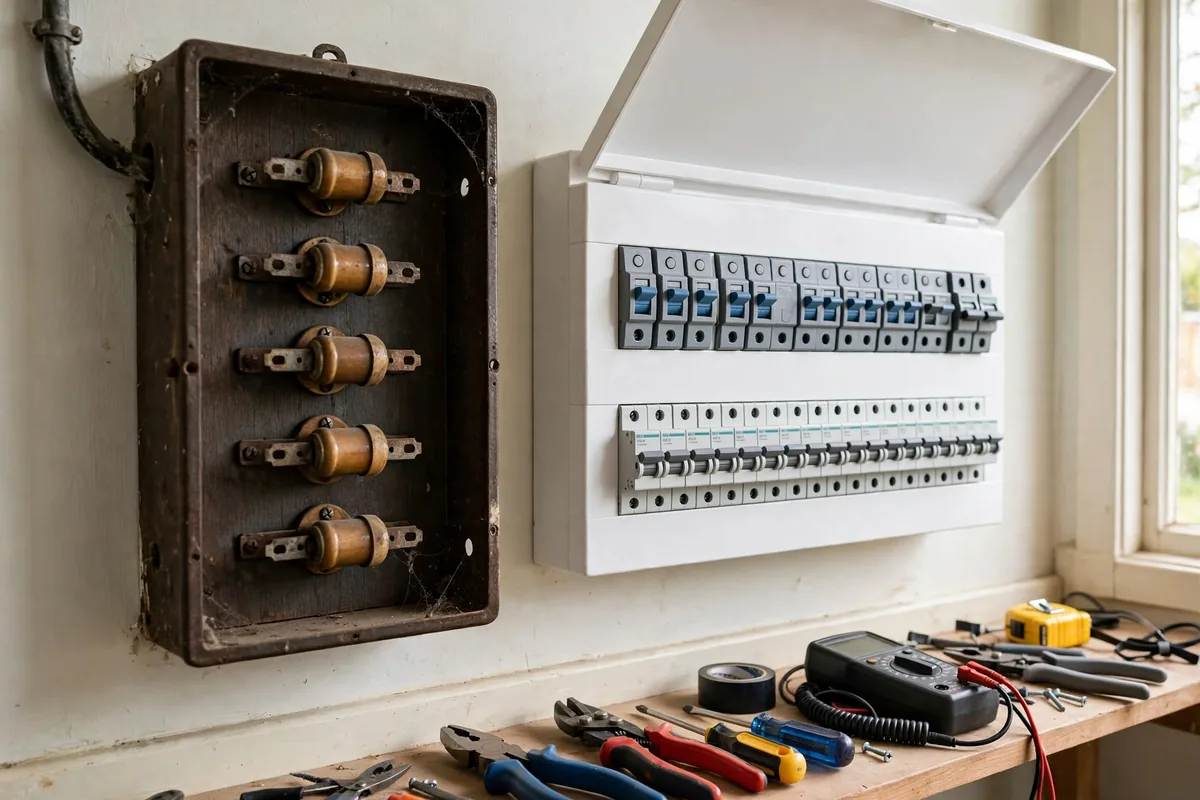
Established suburbs such as Greerton, Welcome Bay, Otūmoetai and parts of the Avenues still have homes running older switchboards, some with ceramic fuses — the rewireable type with fuse wire — that predate modern circuit breakers and RCD protection entirely. These boards served their era, but they were designed for a fraction of modern household demand, they offer no RCD protection as standard, and their condition after decades of service varies. Connecting a continuous EV load to such a board without upgrading it is not something a registered electrician will certify, because it cannot be made compliant and safe as it stands.
The good news is that a board upgrade is not money spent only for the car. Replacing a ceramic fuse board brings modern breakers and RCD protection to your whole home — the oven, the bathroom, the kids' bedrooms — and it is work many older homes need regardless of EVs. Your electrician will quote it separately and transparently. In the context of typical New Zealand pricing, where a full installed charger commonly falls in the market range of about $1,450 to $3,700, a home needing board work will sit toward the higher end — but it ends with a safer house as well as a working charger, and all of it certified.
Warning signs your board needs attention before a charger
Your board may be telling you it is ready for attention. Ceramic fuses are the clearest sign. Others include breakers that trip when several appliances run together, lights that flicker under load, a board that is full with no spare ways, visible heat discolouration, or a switchboard you would describe as a patchwork of additions from different decades. None of these signs mean you cannot have a charger. They mean the conversation starts with the board, and a reputable electrician will welcome that conversation rather than glossing over it to win the job.
Equally, treat certain installer behaviour as a warning sign about the installer. Anyone willing to connect a charger without inspecting the switchboard, anyone proposing to run it from an existing socket circuit permanently, and anyone who cannot explain what protection the circuit will have, is cutting corners that exist for your protection. The CoC system only works if the person signing it actually did the work to standard. Choosing your installer on registration, assessment and paperwork — not just price — is how that system protects you.
How to use these rules when you compare quotes
You do not need electrical knowledge to use these rules well; you need five questions. Is the installer a registered electrician? Will the charger be on its own dedicated circuit? What Type B RCD or equivalent protection is included? Will I receive a Certificate of Compliance on completion? And has my switchboard's capacity been assessed, with any extra work itemised before we start? A good installer answers all five without hesitation, usually before you ask, because that is simply how their normal process works.
Write the answers into your decision alongside price. A quote that includes correct protection, certification and any necessary board work is not expensive compared with a quote that omits them — it is complete. The incomplete quote only looks cheaper until the missing pieces reappear as risk, rework or a compliance problem when you sell or claim insurance. Get the assessment, ask the five questions, and let a registered electrician carry the responsibility they are licensed to carry. That is the system working exactly as New Zealand designed it to.
Get Help With EV Charging in Tauranga
Reading only gets you so far — your switchboard, your car and your parking spot decide the real answer. We connect Tauranga homeowners with local registered electricians who install and certify home chargers every week.